

S&P 500: 0.34% DOW: -0.42% NASDAQ: -0.17% 10-YR Yield: 4.24%
What Happened?
An eventful stretch of headlines left markets on a seesaw this week, with investors whipsawed between a new Fed Chair, the kickoff of Q4 earnings, and sharp moves in real assets. Equity indices chopped around as leadership narrowed again into mega-cap tech, while cross-currents in rates, the dollar, and commodities amplified day-to-day volatility.
Q4 earnings reminded everyone that, even as markets slowly rotate away from total dependence on the “Mag 7,” the tape still lives and dies by a handful of tech giants. Apple and Microsoft were among the marquee reporters: Microsoft underscored its massive AI capital expenditure plans, but revenue growth only inched ahead, raising questions about how quickly those AI investments will translate into monetization. That disconnect was enough to pressure the broader indices, given how much index-level earnings expectations are concentrated in a few AI-linked names.
At the same time, macro sentiment was dominated by Fed Chair headlines and what the shift in leadership could mean for the policy path from here. Fears around central bank independence and a more politically influenced Fed briefly pushed investors deeper into perceived safe havens and sent rate expectations bouncing along the curve.
That policy angst showed up most clearly in the real asset complex, where price action looked more like a roller coaster than a refuge. Precious metals surged alongside a weakening dollar and speculative positioning in futures, before reversing as the narrative shifted. Crypto traded heavy, the dollar wobbled, and commodities broadly repriced as investors tried to reconcile higher real yields, AI-driven growth optimism, and a potentially less accommodative Fed.
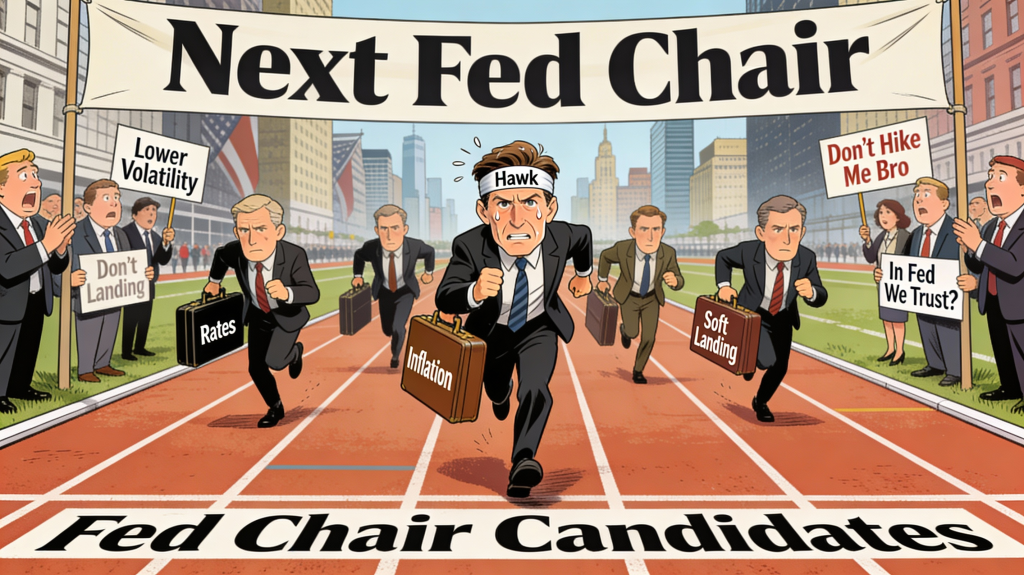
Trump Picks Kevin Warsh as Fed Chair
- Warsh’s appointment likely lowers perceived political risk around Fed independence, but raises the odds of a structurally tighter policy bias at the margin.
- His past criticism of the Fed’s reluctance to cut and his “hawk” reputation create a signaling gap that markets will price through every dot, press conference, and speech.
The key takeaway – On Friday morning, Trump announced Kevin Warsh as his candidate for Federal Reserve chair. The nomination follows months of debate over who would succeed Jerome Powell at the end of his term in mid-May. Warsh’s experience includes the role he played on the Fed’s board of governors during the financial crisis of 2008 where he gained a reputation for being an inflation “hawk”. As the Fed chair, he’ll plays a critical role in leading the Federal Open Market Committee through eight meetings each year, where together they determine the direction of interest rates and how to run monetary policy. These decisions are guided by Fed’s dual mandate of maximizing employment and low inflation, which ultimately set interest rates for every facet of the economy and market.
This past year, the central bank has faced significant criticism for its reluctance to substantially lower interest rates, as inflation has remained above its 2% target since before the Covid era. The current administration, however, has strongly encouraged further interest rate cuts in an effort to stimulate economic growth, reduce the cost of debt and make housing more affordable. Warsh, himself, has also been critical of the Fed’s recent decisions and expresses a preference for lower rates. That said, the Fed rate decision is still a committee-based process, leaving the directions of interest rates uncertain.
In that context, his move from outside critic to insider-in-chief is a bit ironic: the same institution he chastised for staying too tight for too long is now one he must convince markets he can lead with restraint. Whether his prior critiques translate into consistent policy or convenient amnesia will be one of the more interesting subplots for investors to watch.

Silver, gold sell off as precious metals markets nosedive
- Gold spiked nearly 20% over the past month and roughly 90% year-over-year.
- Silver rallied even harder, briefly up about 65% in January and more than 200% versus a year ago before a one-day drop of roughly 20–30% as the speculative trade cracked.
- The nomination of Kevin Warsh’s as Fed Chair sent precious metals falling.
The key takeaway – Gold and silver, traditionally seen as steady safe havens, acted anything but calm this week. Following the announcement of the new Federal Reserve Chair, the precious metals market saw its sharpest selloff in decades; an unexpected reversal for assets that had recently been surging.
So, what sparked the earlier rally? A weakening U.S. dollar combined with a wave of speculative futures activity sent metals soaring. As traders crowded into short positions, a cascading short squeeze pushed prices even higher. Gold briefly touched multi-month highs, with silver following closely behind. The upward momentum, however, wasn’t entirely driven by fundamentals, it was fuelled by leverage, speculation, and uncertainty around the Fed’s future leadership.
That uncertainty cleared when Kevin Warsh, a known inflation hawk, was announced as the next Fed Chair. His appointment reassured investors about the Fed’s independence and signaled a potentially tighter monetary stance ahead. As inflation fears subsided, investors unwound long positions in metals. Leveraged traders caught on margin found themselves forced to liquidate, accelerating the fall. By week’s end, gold and silver had logged their worst single-day declines in years.
From Around the Watercooler

Pennsylvania Wins Bid for Eli Lilly Weight-Loss Drug Factory
Trump, Democrats Say Deal Reached to Avert Shutdown
OpenAI Plans Fourth-Quarter IPO in Race to Beat Anthropic to Market
Former Google engineer found guilty of espionage and theft of AI tech