


S&P 500: -0.44% DOW: -1.31% NASDAQ: -0.95% 10-YR Yield: 3.97%
What Happened?
The week began with Monday’s tariff hangover as Trump’s new 10% global tariff kicked in, sending the S&P down 1% and the Dow tumbling 1.7%. But the real drama arrived Wednesday night when Nvidia reported numbers that should have sparked celebration: $68.1 billion in quarterly revenue (up 73% year over year), crushing the $66.2 billion consensus, with guidance of $78 billion for the next quarter against expectations of $72.3 billion. The market’s response? Nvidia’s stock cratered 5.6% on Thursday, erasing roughly $260 billion in market cap in its worst single-day drop since April. By Friday, the Nasdaq was on track for its steepest monthly drop since March 2025, falling below its 50-day moving average for the 17th consecutive session. The bar for AI winners has been set so stratospherically high that even blowout results now feel like disappointments.
The rotation story from last week accelerated. Software stocks, already battered by AI disruption fears and down nearly 20% year to date, staged a sharp Tuesday rally (the software index up 1.4%, IGV surging 2.4%) after Anthropic announced enterprise partnerships, with IBM jumping 3.5%, Intuit up 2.8%, and Salesforce climbing 4%. But the relief proved fleeting, fading by week’s end as fears returned. Payment processors like Visa and Mastercard got hammered Monday on concerns that AI would slash consumer spending, while IBM had earlier suffered a 13% single-day plunge after Anthropic’s Claude Code threatened its legacy maintenance business. Yet here’s the twist buried in the wreckage: cyclical sectors are quietly building momentum. Last week’s Industrials, Materials, and Energy leadership extended into this week’s trading, with Healthcare and Consumer Staples also holding ground. The Russell 2000 small-cap index continues outperforming, up 5.6% year to date versus the tech-heavy Nasdaq’s slide. Goldman Sachs noted that sector breadth is improving even as headline indices stall, a sign that the market is pricing “sector rotation with tariff noise” rather than systemic collapse.
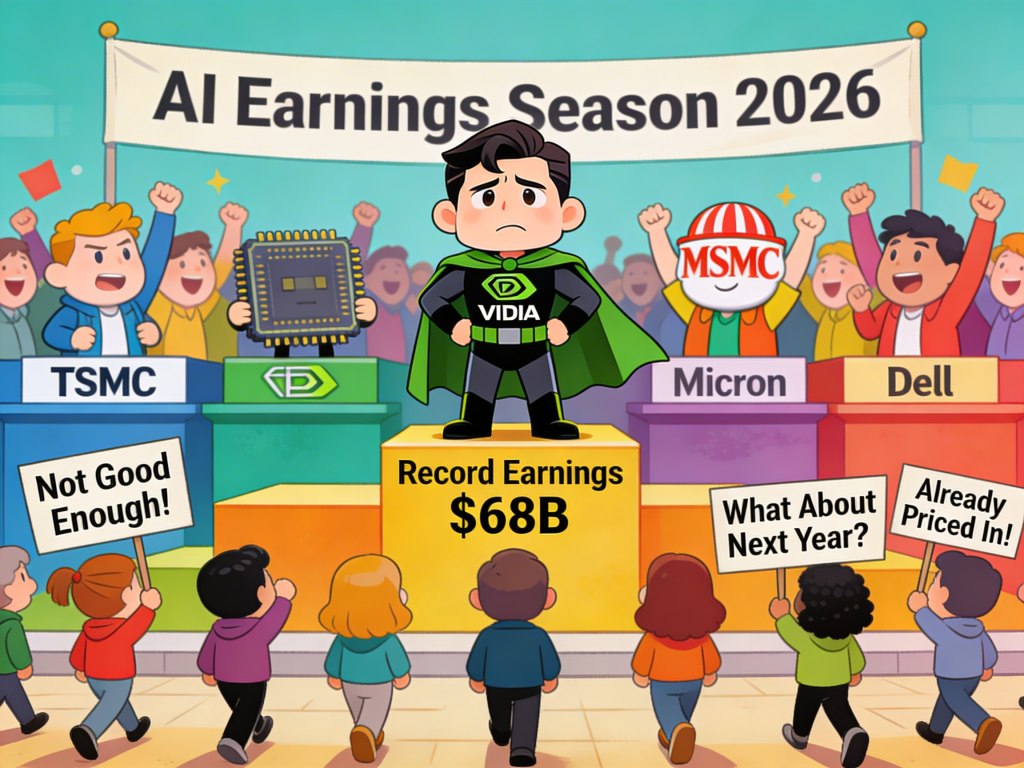
Nvidia’s blowout earnings report disappoints Wall Street
- Revenue beat by $1.9 billion, but investors wanted proof that hyperscale cloud customers won’t slow AI capex spending.
- Blackwell chip demand remains strong, yet concerns mount about whether customers can monetize their massive AI investments.
- Nvidia accounts for more than half of the S&P 500’s decline Thursday despite most constituent stocks rising, showing its outsized index influence.
The key takeaway – Wednesday night’s Nvidia earnings call delivered results that would have been unthinkable a decade ago: $68.1 billion in quarterly revenue (up 73% year over year), adjusted EPS of $1.62 (beating estimates), and forward guidance of $78 billion for the next quarter when Wall Street penciled in just $72.3 billion. The data center division, home to Nvidia’s AI chips, accounted for 91% of total sales at $62.3 billion, crushing the $60 billion consensus. CEO Jensen Huang declared, “Our customers are racing to invest in compute, powering the industrial revolution of their future”. The market’s verdict? A resounding “meh.” Nvidia shares rose 1.3% in premarket trading Thursday before reality set in. By market close, the stock had plummeted 5.6%, wiping out approximately $260 billion in market capitalization in a single session.
The sell-off reflects a broader shift in market psychology. Morgan Stanley analysts noted that the “construction phase” of AI infrastructure is giving way to a more skeptical “monetization and efficiency” era. Simply beating estimates no longer sustains record-high multiples when investors start questioning the return on investment for AI spending. The PHLX Semiconductor Index (SOX) fell 3% in tandem with Nvidia Thursday, dragging Taiwan Semi, AMD, and Micron lower despite their own strong fundamentals. HSBC lowered its Nvidia price target to $295 (still well above the current price range around $250), citing valuation gravity even while maintaining a buy rating.
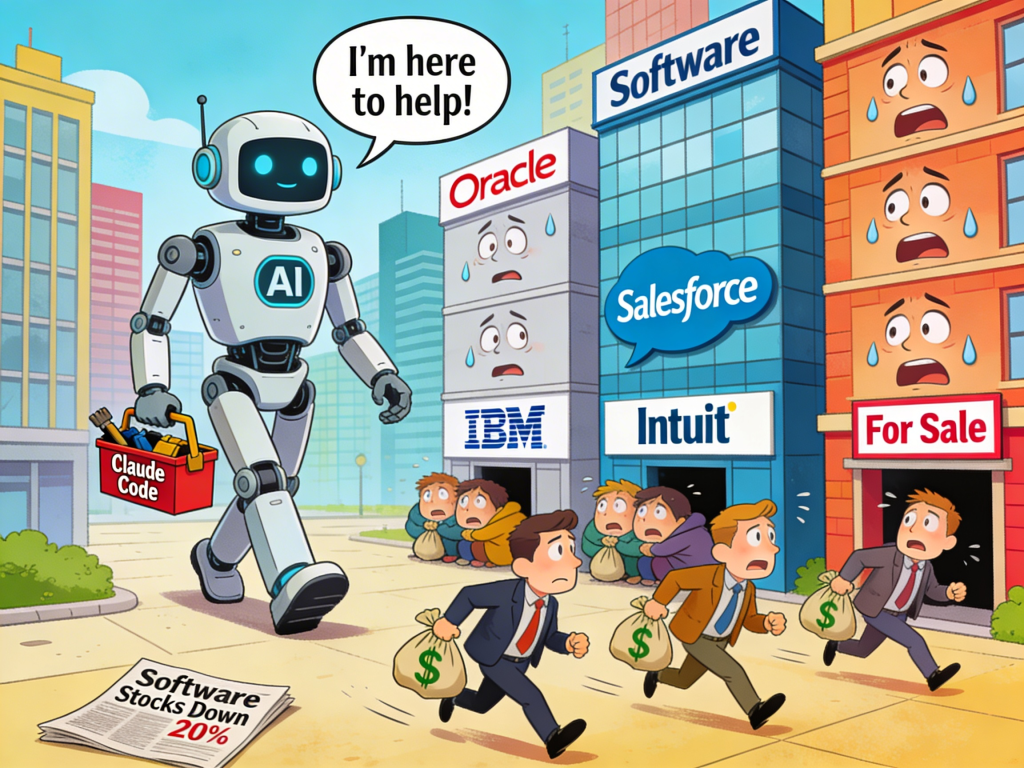
AI-linked fears roil some corners of Wall Street after years of hype and gains
- Software & Services index down 20% year to date versus Nasdaq’s more modest 2.6% decline, showing concentrated pain.
- Tuesday’s relief rally (software stocks up 2.1%) faded by Friday as Salesforce’s post-earnings bounce couldn’t sustain momentum.
- Consulting firms Accenture and Cognizant sold off alongside software names, extending disruption fears beyond pure tech.
The key takeaway – The iShares Software ETF (IGV) is down nearly 20% year to date, with individual names suffering even steeper declines: Salesforce off 30%, Intuit down 45%, Autodesk shedding 25%, and Snowflake slumping over 20%. Monday delivered the week’s harshest blow when the software index hit a ten-month low, triggered by a viral Citrini Research report warning of a potential 2028 scenario where AI-driven layoffs push unemployment to 10.2% as software and delivery applications get replaced en masse. The fear is two-sided and somewhat contradictory: one narrative warns that AI will render traditional software products obsolete, as tools like Anthropic’s Claude Code enable “vibe coding” where non-programmers write their own software. The other argues that software firms overspent on AI capex without achieving sufficient ROI. IBM’s 13% single-day plunge Monday (its worst since October 2000) exemplified the panic, as Anthropic’s Claude Code threatened IBM’s lucrative maintenance and modernization services.
But Tuesday’s relief rally offered a glimmer of hope. After Anthropic announced enterprise partnerships and new integrations for its Claude Cowork tool, software stocks staged a sharp rebound, with investors betting much of the disruption fear was already priced in. Salesforce’s better-than-expected earnings Wednesday night (beating profit forecasts despite being down 30% year to date) reinforced the notion that quality software firms with proprietary data and complex workflows can weather AI competition. Edward Jones’ Mona Mahajan noted that “despite the drastic fluctuations in stock prices, the fundamental businesses have not significantly changed,” suggesting the market’s reaction remains more speculative than grounded in actual business deterioration.
From Around the Watercooler

Altman Says OpenAI Is Working on Pentagon Deal Amid Anthropic Standoff
Mortgage Rates Fall Below 6% for the First Time Since 2022
Americans Are Leaving the U.S. in Record Numbers
The new anti-AI trade sweeping Wall Street: ‘HALO’
Disclousure:
Investing involves risk, including the possible loss of principal and fluctuation of value. Past performance is no guarantee of future results.
This newsletter is not intended to be relied upon as forecast, research or investment advice, and is not a recommendation, offer or solicitation to buy or sell any securities or to adopt any investment strategy. The opinions expressed are as of the date noted and may change as subsequent conditions vary. The information and opinions contained in this letter are derived from proprietary and nonproprietary sources deemed by Waterloo Capital to be reliable. The letter may contain “forward-looking” information that is not purely historical in nature. Such information may include, among other things, projection, and forecasts. There is no guarantee that any forecast made will materialize. Reliance upon information in this letter is at sole discretion of the reader. Please consult with a Waterloo Capital financial advisor to ensure that any contemplated transaction in any securities or investment strategy mentioned in this newsletter aligns with your overall investment goals, objectives and tolerance for risk. Additional information about Waterloo Capital is available in its current disclosure documents, Form ADV, Form ADV Part 2A Brochure, and Client Relationship Summary report which are accessible online via the SEC’s investment Adviser Public Disclosure (IAPD) database at www.adviserinfo.sec.gov, using SEC # 133705. Waterloo Capital is neither an attorney nor an accountant, and no portion of this content should be interpreted as legal, accounting or tax advice.