


MARKET COMMENTARY
U.S. indexes are starting the week on a more constructive note, with stocks and bonds both finding relief as oil prices pulled back from last week’s highs. A trickle of tankers has begun moving through the Strait of Hormuz, offering some cautious optimism that the worst of the shipping disruption may be easing. The conflict in Iran has now entered its third week, and while the IEA has signaled it can release additional reserves if needed, the situation remains fluid. A prolonged war that keeps upward pressure on energy prices longer than expected is still a meaningful worry for markets, particularly given the slight stagflation risk it reintroduces. For now, though, the modest decline in crude has taken some of the edge off sentiment.
All eyes this week will be on the Federal Reserve, where Jerome Powell and company are widely expected to hold rates steady. The more interesting question is what comes after March. If the conflict continues to pull the Fed’s dual mandate in opposite directions – inflation pressured higher by energy costs while growth faces headwinds from uncertainty and softer labor data – the path forward becomes genuinely difficult to map. The notably weak February jobs report, which showed outright job losses and pushed unemployment to 4.4%, remains fresh context for that debate. Markets will be listening closely to Powell’s language for any signal about how the Fed is thinking through that tension.
Technically, conditions remain unsettled but have improved at the margin today. The VIX has fallen sharply from its recent spike above 30, though it continues to sit at elevated levels, a reminder that the underlying environment still carries meaningful risk. Index moves remain headline driven, and prices sit in a large range dating back to late 2025.
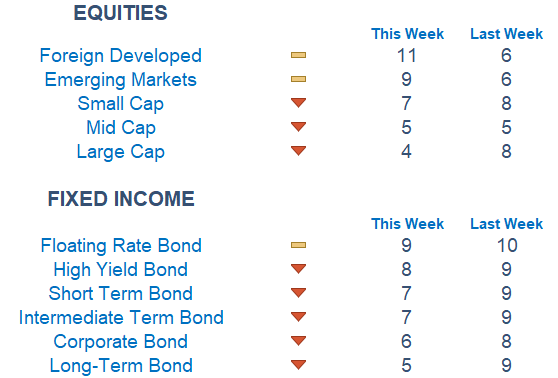
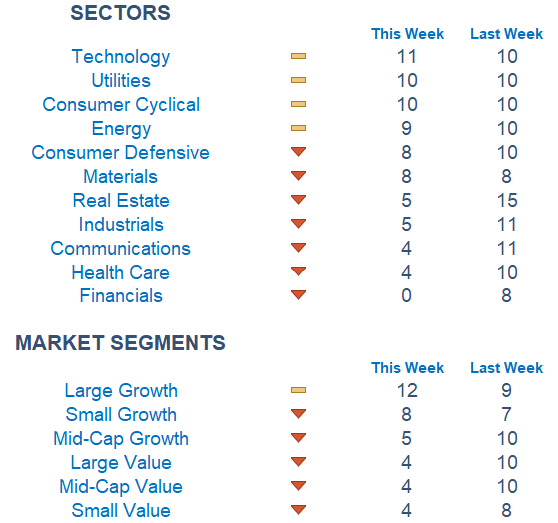
Our Newton model has been picking up an interesting shift. We are seeing a rotation back toward beaten down growth sectors on a relative basis – a reversal from the defensive tilt that characterized much of last month’s signal. Although the rotation into growth is notable, it is worth watching whether that move has staying power given the broader macro uncertainties still in play.
Economic Releases This Week
Monday: Empire State Manufacturing Survey, Home Builder Confidence Index
Tuesday: Pending Home Sales
Wednesday: Producer Price Index, FOMC Interest Rate Decision
Thursday: New Home Sales, Initial Jobless Claims
Friday: None
Stories to Start the Week
Meta is planning sweeping layoffs that could affect 20% or more of the company to offset AI bets.
Formula 1 cancelled its Bahrain and Saudi Arabia races due to the war in Iran
Here is a recap of the Oscars where One Battle After Another took home 6 awards.
OpenAI is in advanced discussions to form a joint venture with private equity firms.

Our Newton model attempts to determine the highest probability of future price direction by using advanced algorithmic and high-order mathematical techniques onthe current market environment to identify trends in underlying security prices. The Newton model scores securities over multiple time periods on a scale of 0-20 with 0 being the worst and 20 being the best possible score.
Trend & level both matter. For example, a name that moves from an 18 to a 16 would signal a strong level yet slight exhaustion in the trend.
Technical trading models are mathematically driven based upon historical data and trends of domestic and foreign market trading activity, including various industry and sector trading statistics within such markets. Technical trading models, through mathematical algorithms, attempt to identify when markets are likely to increase or decrease and identify appropriate entry and exit points. The primary risk of technical trading models is that historical trends and past performance cannot predict future trends and there is no assurance that the mathematical algorithms employed are designed properly, updated with new data, and can accurately predict future market, industry and sector performance.
Disclousure:
Investing involves risk, including the possible loss of principal and fluctuation of value. Past performance is no guarantee of future results.
This newsletter is not intended to be relied upon as forecast, research or investment advice, and is not a recommendation, offer or solicitation to buy or sell any securities or to adopt any investment strategy. The opinions expressed are as of the date noted and may change as subsequent conditions vary. The information and opinions contained in this letter are derived from proprietary and nonproprietary sources deemed by Waterloo Capital to be reliable. The letter may contain “forward-looking” information that is not purely historical in nature. Such information may include, among other things, projection, and forecasts. There is no guarantee that any forecast made will materialize. Reliance upon information in this letter is at sole discretion of the reader. Please consult with a Waterloo Capital financial advisor to ensure that any contemplated transaction in any securities or investment strategy mentioned in this newsletter aligns with your overall investment goals, objectives and tolerance for risk. Additional information about Waterloo Capital is available in its current disclosure documents, Form ADV, Form ADV Part 2A Brochure, and Client Relationship Summary report which are accessible online via the SEC’s investment Adviser Public Disclosure (IAPD) database at www.adviserinfo.sec.gov, using SEC # 133705. Waterloo Capital is neither an attorney nor an accountant, and no portion of this content should be interpreted as legal, accounting or tax advice.